 Tiếng Việt
Best VPN Protocols for Linux VPS – Comparison & Setup Guide

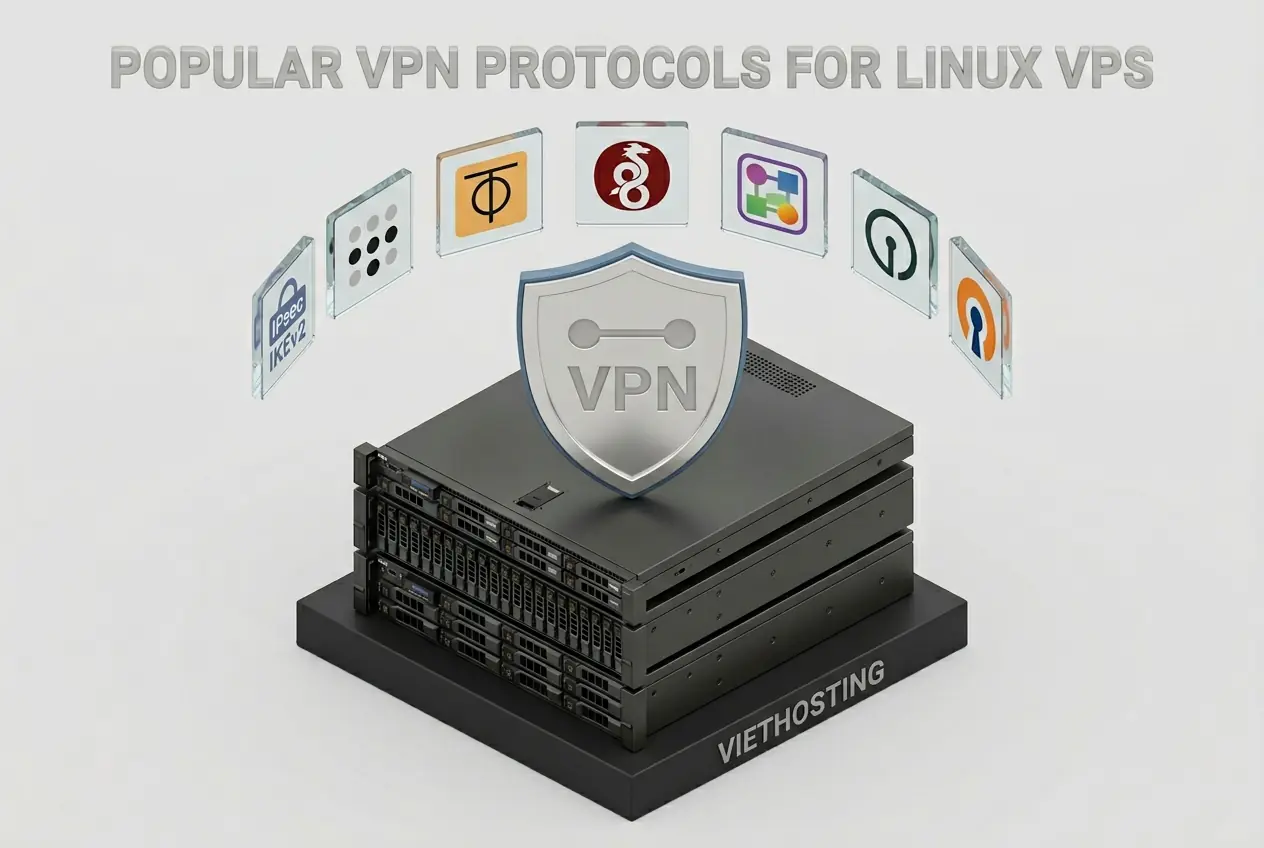
Choosing the best VPN protocol for a Linux VPS completely depends on your specific networking requirements: do you need maximum speed (WireGuard), flexible connectivity without a Public IP (Tailscale, ZeroTier), strict firewall evasion (Outline VPN), or enterprise-grade compatibility with Native Clients (IPsec/IKEv2, SoftEther)?
This article serves as your Knowledge Hub. We analyze and compare the pros and cons of the 6 most popular VPN protocols today, provide detailed performance benchmarks, and guide you in selecting the right virtual private network solution to self-host on your Linux server.
* Note: In this article, the term "VPN" refers to VPN protocols used to build a self-hosted VPN server on a Linux VPS, not commercial VPN subscription services.
By deploying VPN protocols on a Linux VPS, you can build a dedicated private VPN server to secure traffic, enable remote access, and connect multiple networks over the Internet. In this article, we will compare today's most popular VPN protocols to help you choose the right solution for your VPS.
The modern ecosystem of virtual private network (VPN) protocols has evolved far beyond the constraints of pre-installed commercial apps on personal devices. For System Administrators (SysAdmins) and enterprises, mastering the infrastructure to operate a Self-hosted VPN on a VPS grants the ultimate privilege of absolute control over data privacy, bandwidth allocation, and custom routing. However, faced with a myriad of complex protocols—from Layer 2 and Layer 3 to Overlay Proxies—which standard is the true "perfect match" for your security architecture?
- 1. Why Build a Self-Hosted VPN on a Linux VPS?
- 2. WireGuard: The High-Speed VPN Protocol
- 3. Tailscale & ZeroTier: Next-Gen Mesh VPN Protocols
- 4. IPsec/IKEv2 (strongSwan): The Enterprise Standard
- 5. SoftEther VPN: The Multi-Purpose "Swiss Army Knife" Protocol
- 6. Outline VPN: The Proxy Protocol Antidote to DPI
- 7. OpenVPN: The Reliable Veteran VPN Protocol
- 8. Master Benchmark & Performance Comparison
- 9. Which VPN Protocol Should You Choose?
- 10. Choosing a Reliable VPS for VPN at VietHosting
- 11. Conclusion
1. Why Build a Self-Hosted VPN on a Linux VPS?
Instead of purchasing commercial Public VPN subscriptions (like NordVPN or ExpressVPN), renting a Linux VPS to configure your own VPN brings irreplaceable advantages:
2. WireGuard: The High-Speed VPN Protocol
WireGuard triggered a genuine revolution when it was merged directly into the Linux Kernel (from version 5.6). It strips away hundreds of thousands of redundant lines of code found in legacy protocols, delivering unparalleled encryption performance.
- Pros: Extremely high speeds (fastest available), consumes very little RAM/CPU, lightweight and easily auditable codebase, instantaneous connection handshakes (Stateless).
- Cons: Supports UDP only, making it susceptible to strict corporate or national firewall blocking. Lacks the flexible dynamic IP (DHCP) allocation seen in other protocols.
- Guide: How to Install WireGuard VPN on a Linux VPS (Complete Guide).
3. Tailscale & ZeroTier: Next-Gen Mesh VPN Protocols
If you have multiple devices (PCs, NAS, Servers) stationed behind routers without Public IPs (trapped behind CGNAT), Tailscale and ZeroTier are miraculous. They establish a Peer-to-Peer (P2P) Mesh Network that pierces through NAT layers.
- Tailscale: Built upon the WireGuard protocol, integrating superb SSO (Google, Microsoft) identity management perfect for Enterprise Zero Trust architectures.
👉 How to Install Tailscale VPN on a Linux VPS (Complete Guide). - ZeroTier: Provides a global Virtual Switch (Layer 2), supporting Broadcast/Multicast protocols, making it flawless for bridging physical LANs or internal gaming.
👉 How to Install ZeroTier VPN on a Linux VPS (Complete Guide).
4. IPsec/IKEv2 (strongSwan): The Enterprise Standard
This is the only protocol where you do not need to force employees to download any additional applications, as it is natively supported on iOS, macOS, and Windows.
- Pros: Perfect Native Client support. The MOBIKE feature allows mobile devices to transition from Wi-Fi to 4G without dropping the network connection. It remains the industry standard for bridging physical routers (Cisco, MikroTik).
- Cons: Server-side Public Key Infrastructure (PKI) certificate configuration is quite complex. It is easily blocked by Firewalls due to its reliance on specific Ports 500/4500.
- Guide: How to Install IPsec/IKEv2 VPN on a Linux VPS (Complete Guide).
5. SoftEther VPN: The Multi-Purpose "Swiss Army Knife" Protocol
A single software daemon capable of broadcasting and accepting multiple protocols simultaneously: OpenVPN, L2TP/IPsec, SSTP, and its proprietary SoftEther protocol.
6. Outline VPN: The Proxy Protocol Antidote to DPI
When all aforementioned protocols are intercepted by national firewalls or Deep Packet Inspection systems, Outline VPN (utilizing Shadowsocks) represents the ultimate escape route.
- Pros: No connection signature. VPN traffic is AEAD encrypted and disguised as standard web access packets, evading the strictest filtering mechanisms. 1-click configuration via Outline Manager.
- Cons: Its sole purpose is web browsing (Proxying). It cannot be utilized to construct internal Site-to-Site LANs for servers.
- Guide: How to Install Outline VPN on a Linux VPS (Complete Guide).
7. OpenVPN: The Reliable Veteran VPN Protocol
The oldest protocol, universally compatible with nearly every operating system in existence. While its speed has been vastly outpaced by newer protocols, its legendary stability and granular encryption options keep OpenVPN highly relevant.
- Pros: Extremely reliable, capable of operating on both TCP and UDP, and can easily penetrate basic Firewalls using TCP Port 443.
- Cons: A massive code base, the slowest speeds on this list, and noticeably higher battery consumption on mobile devices.
- Guide: Install OpenVPN on a VPS with One Command (Auto Installer).
8. Master Benchmark & Performance Comparison
Review the comprehensive strengths of these protocols to gain a clear perspective before making your deployment decision:
| VPN Protocol | Speed & Performance | Firewall Evasion (DPI Bypass) | Native Client Support | Setup Difficulty |
|---|---|---|---|---|
| WireGuard | 10/10 (Highest) | Poor (Easily Identified) |  |
Easy |
| IPsec / IKEv2 | 9/10 (Via Hardware AES-NI) | Poor (Fails if Port 500 is blocked) |  (Win, Mac, iOS, Android) (Win, Mac, iOS, Android) |
Very Hard |
| Tailscale / ZeroTier | 8/10 (High on direct P2P) | Good (NAT traversal via Relays) | |
Very Easy |
| Outline VPN | 8/10 | 10/10 (Excellent Bypass) | |
Very Easy (Docker GUI) |
| SoftEther VPN | 8/10 (High CPU usage) | Good (via HTTPS Obfuscation) | (Via L2TP/IPsec) |
Moderate |
| OpenVPN | 6/10 (Slowest) | Poor | |
Moderate |
9. Which VPN Protocol Should You Choose?
Match your practical needs against these standard scenarios to find your ultimate solution:
| Primary Use Case | Recommended Protocol |
|---|---|
| Optimizing for maximum speed to play games, download files, or stream 4K video. Operating on stable networks. | 👉 WireGuard |
| Managing home Servers/NAS (Homelab) or securely connecting corporate devices that lack static Public IPs. | 👉 Tailscale or ZeroTier |
| Living or working in areas with restricted network environments. Needing to easily share safe connections. | 👉 Outline VPN |
| Establishing branch networks or provisioning mobile VPNs for employees without forcing them to install unfamiliar apps. | 👉 IPsec/IKEv2 (strongSwan) |
| Legacy networks requiring virtual IPs with integrated DHCP, or needing to blend multiple protocols into a single Server. | 👉 SoftEther VPN |
10. Choosing a Reliable VPS for VPN at VietHosting
Whether you select a lightweight algorithm like WireGuard or a complex encryption framework like IPsec, your "transit vehicle"—the Linux VPS—must guarantee robust specifications, unmetered bandwidth, and absolute stability. At VietHosting, we provide:
- True 100% KVM Virtualization: VPN protocols interact deeply with the Network Kernel (especially WireGuard and IPsec). KVM grants you a fully independent Linux kernel, ensuring all VPN modules operate fluidly without the limitations inherent to OpenVZ virtualization.
- Enterprise CPU Performance: Our infrastructure deploys Dell Enterprise servers featuring Intel Xeon Platinum processors equipped with hardware AES-NI instruction sets, ensuring massive data encryption processes never hit a processing bottleneck.
- High-Speed & Unmetered Bandwidth: 1Gbps network ports bundled with Unmetered Data Transfer. Our clean IP pools safeguard your VPN from international blacklists.
11. Conclusion
There is no single "best" VPN protocol for every scenario. WireGuard is suitable for maximum performance, Tailscale and ZeroTier are ideal for Mesh networks, IPsec/IKEv2 is the enterprise standard, while Outline VPN excels at handling restricted network environments.
By deploying these protocols on a stable Linux VPS, you can build a virtual private network system that is flexible, secure, and completely under your control.
Deploy a high-performance virtual server and flexibly install any VPN management system to establish absolutely secure connections for your enterprise.
Comprehensive Guides to Deploying VPN Protocols on Linux VPS
Access the in-depth technical articles below for hands-on deployment of your chosen protocol directly onto your Linux VPS system:
- How to Install WireGuard VPN on a Linux VPS (Complete Guide)
- How to Install Tailscale VPN on a Linux VPS (Complete Guide)
- How to Install ZeroTier VPN on a Linux VPS (Complete Guide)
- How to Install SoftEther VPN on a Linux VPS (Complete Guide)
- How to Install Outline VPN on a Linux VPS (Complete Guide)
- How to Install IPsec/IKEv2 VPN on a Linux VPS (Complete Guide)
- Install OpenVPN on a VPS with One Command (Auto Installer)