 Tiếng Việt
Install OpenVPN Server on a VPS with One Command


In the era of remote work and cross-border e-commerce, utilizing cheap public VPN services exposes you to data leaks and account bans due to shared IP addresses that are often blacklisted. The ultimate solution is building your own enterprise-grade Self-Hosted VPN Server on a Virtual Private Server.
You can deploy an OpenVPN Server on a Linux VPS (Ubuntu, AlmaLinux, Rocky) using just a single command via VietHosting's automated script:
curl -O https://mirrors.viethosting.com/scripts/openvpn-installer.sh && bash openvpn-installer.shThis script automatically installs OpenVPN, generates the Easy-RSA certificate authority, configures Firewall Masquerade routing, and generates a ready-to-use .ovpn client configuration file.
1. What is the OpenVPN Server Auto Installer?
The OpenVPN Server Auto Installer is a production-ready Bash script developed by VietHosting. It transforms a standard Linux VPS into a secure VPN server gateway, where all connected users share the server's single Public IP address to access the internet.
Key Features of the Script:
- Hardened Security: Utilizes robust AES-256-GCM and SHA256 encryption, strictly integrating the tls-crypt feature to hide OpenVPN packet signatures from Deep Packet Inspection (DPI) censorship systems.
- Pre-generated CRL: Automatically initializes the Certificate Revocation List (CRL) during setup. This ensures that revoking compromised user accounts is executed securely and takes effect instantly.
- Smart Log Management (Logrotate): Features a built-in log rotation mechanism. This entirely prevents the server's storage from crashing due to bloated log files—a common issue in many unoptimized installation scripts.
- Batch User Creation: The interactive CLI menu supports generating dozens or hundreds of VPN accounts simultaneously without repetitive typing, saving massive amounts of time for system administrators.
- Broad OS Compatibility: Operates flawlessly and stably across a wide range of Linux distributions, from legacy CentOS 7 (Vault) to the latest RHEL/Alma/Rocky 8, 9, 10, and Ubuntu 22.04+.
2. The VPN Server Architecture Post-Installation
By completing this 2-minute tutorial, you will own a private, fully functional VPN server with the following data flow:
   [ CLIENT DEVICE ]
 (Laptop, Smartphone)
           |
           | 1. Encrypted Tunnel
           ▼
  [ LINUX VPS SERVER ]
 (OpenVPN, Static IP)
           |
           | 2. NAT / Routing
           ▼
      [ INTERNET ]
(Websites, Intranet)- An OpenVPN Server secured with double-layered anti-leak encryption.
- An exclusive, Dedicated Static IPv4 not shared with other users.
- A standardized Firewall Masquerade routing infrastructure safely translating internal packets to the Internet.
- Auto-generated .ovpn configuration files embedded with necessary certificates, ready to distribute to your team's devices.
- An intuitive CLI menu to Add, Batch Create, or Revoke user access instantly.
3. Why Do Businesses Need a Self-Hosted VPN Server?
Owning your private VPN server provides core values that commercial giants like NordVPN or Surfshark often cannot fully provide:
| Evaluation Criteria | Public VPN (Nord, Express) | Self-Hosted VPN Server on VPS |
|---|---|---|
| IP Address | Shared with thousands of random users | 100% Dedicated & Static IPv4 |
| Log Policies | Relies purely on the provider's promise | You own the server (Absolute Zero-Logs) |
| Intranet Security | Cannot route to corporate LAN/Local servers | Fully Possible (Port & Routing control) |
| Account Ban Risk (Ads) | Very High (Due to cross-blacklisted IPs) | Extremely Low (Clean Reputation IP) |
4. Step-by-Step OpenVPN Server Installation Guide
You don't need to be a seasoned System Administrator. VietHosting has packaged all the heavy lifting into an automated script.
System Preparation
- A fresh Linux VPS (Ubuntu 22.04/24.04 or AlmaLinux/Rocky 8/9 highly recommended).
- SSH access to your VPS with root privileges.
Execute the Installer Script
In your command-line terminal, paste the following code and hit Enter:
curl -O https://mirrors.viethosting.com/scripts/openvpn-installer.sh && bash openvpn-installer.shThis installation script is hosted directly on VietHosting's internal Mirrors Storage, guaranteeing absolute safety, zero malicious injections, and lightning-fast download bandwidth.
The script will prompt you for basic setup preferences (you can simply press Enter to accept the pre-optimized defaults):
5. Verify Your VPN Connection
Once finished, the system outputs a client configuration file named ceo_laptop.ovpn in your /root/ directory. To verify the setup, follow these steps:
- Use an SFTP client (like WinSCP or FileZilla) to download the .ovpn file to your local computer.
- Install the official OpenVPN Connect application (Available for Windows, macOS, iOS, Android).
- Drag and drop the .ovpn file into the app and click Connect.
- Verify: Open your browser and go to
whatismyip.comor runcurl ifconfig.mein your local terminal. If the output matches your VPS IP, the VPN Server is working correctly.
6. VPN User Management (Batch Creation/Revoke)
The brilliance of this script is its intuitive management menu. To summon the menu at any time, simply re-run the command: bash openvpn-installer.sh
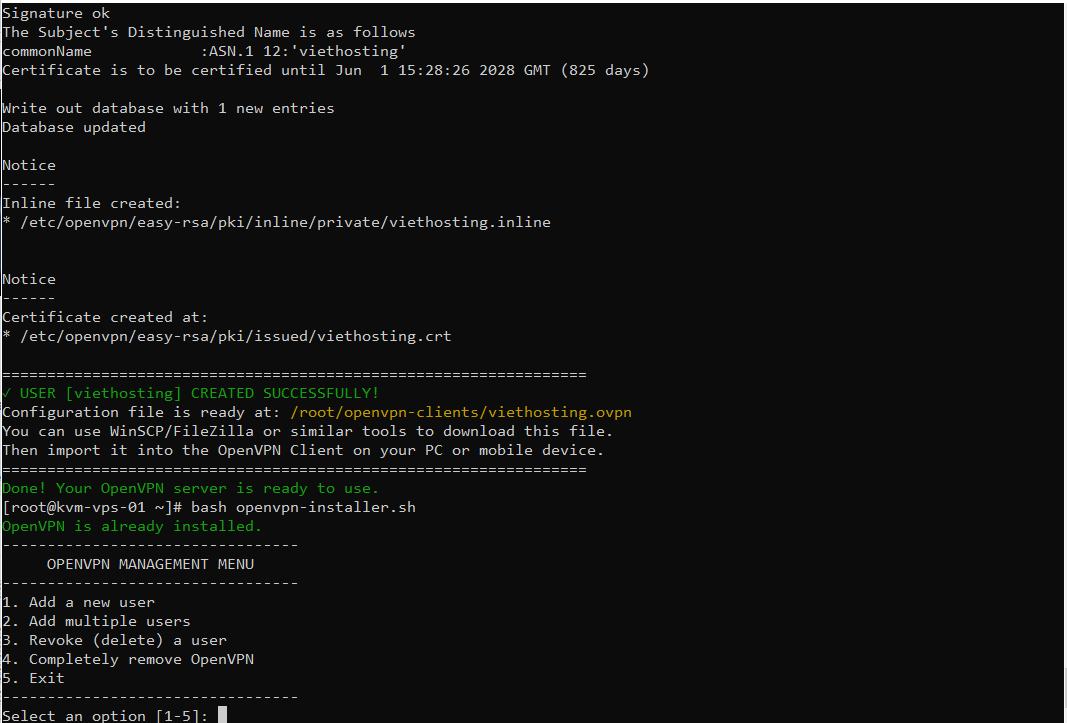
- Add a new user: Select option 1. Enter the new employee's identifier (e.g., marketing_team). The system instantly generates a distinct .ovpn file for them.
- Add multiple users: Select option 2. A fantastic feature for enterprises, allowing administrators to automatically generate dozens of VPN accounts simultaneously without repetitive command typing.
- Revoke (delete) a user: When a device is compromised or staff leaves, select option 3. Their certificate is immediately added to the pre-generated Certificate Revocation List (CRL), terminating their server access instantly and securely.
7. Top Use Cases for Self-Hosted VPNs
8. Why Host Your VPN Server on VietHosting VPS?
VPN encryption (AES-256) requires continuous CPU cycles. Running a VPN Server on a heavily oversold platform will result in significantly reduced throughput.
- True KVM Virtualization: With just a basic KVM VPS (2 vCPU, 2GB RAM) at VietHosting, the dedicated hardware can smoothly handle 20-30 concurrent encrypted connections without facing bottlenecks.
- Pristine IP Reputation: We provide clean IPv4 ranges, strictly filtered through international IP Reputation databases to ensure maximum trustworthiness for e-commerce platforms.
- 1Gbps Bandwidth: Network routing is hyper-optimized for international paths, keeping latency (Ping) consistently low for remote working sessions.
9. Conclusion
Building an enterprise OpenVPN server system is now significantly simpler. With just 1 command line and a premium Linux VPS, you reclaim absolute control over your data flow, secure a clean static IP, and shield your business from cybersecurity threats.
Using cheap, shared VPN services forces you to share IP addresses with policy-violators, triggering automated bans from Facebook, Amazon, or Google. To minimize this risk, you need an exclusive, pristine IPv4 address.
Deploy your private OpenVPN Server today on VietHosting's KVM VPS platform, featuring 1Gbps bandwidth and Enterprise SSDs. Our 24/7 technical team is on standby to help you install this VPN script at no additional cost.
Related Guides & Resources
Explore additional tutorials, technical guides, and infrastructure insights to help you deploy, optimize, and manage VPS or server environments efficiently.
- Top VPN Solutions for Linux VPS: Performance & Comparison
- Install Outline VPN Server on a Linux VPS (Complete Guide)
- How to Install IPsec/IKEv2 VPN Server on a Linux VPS (2026)
- SoftEther VPN Server Multi IP – Assign Dedicated IP per User
- What is KVM VPS? The Benefits of KVM Virtualization
- What Is a Vietnam Server? Benefits & Offshore Comparison