 Tiếng Việt
What Is an SSL Certificate? How It Works, Benefits & Types

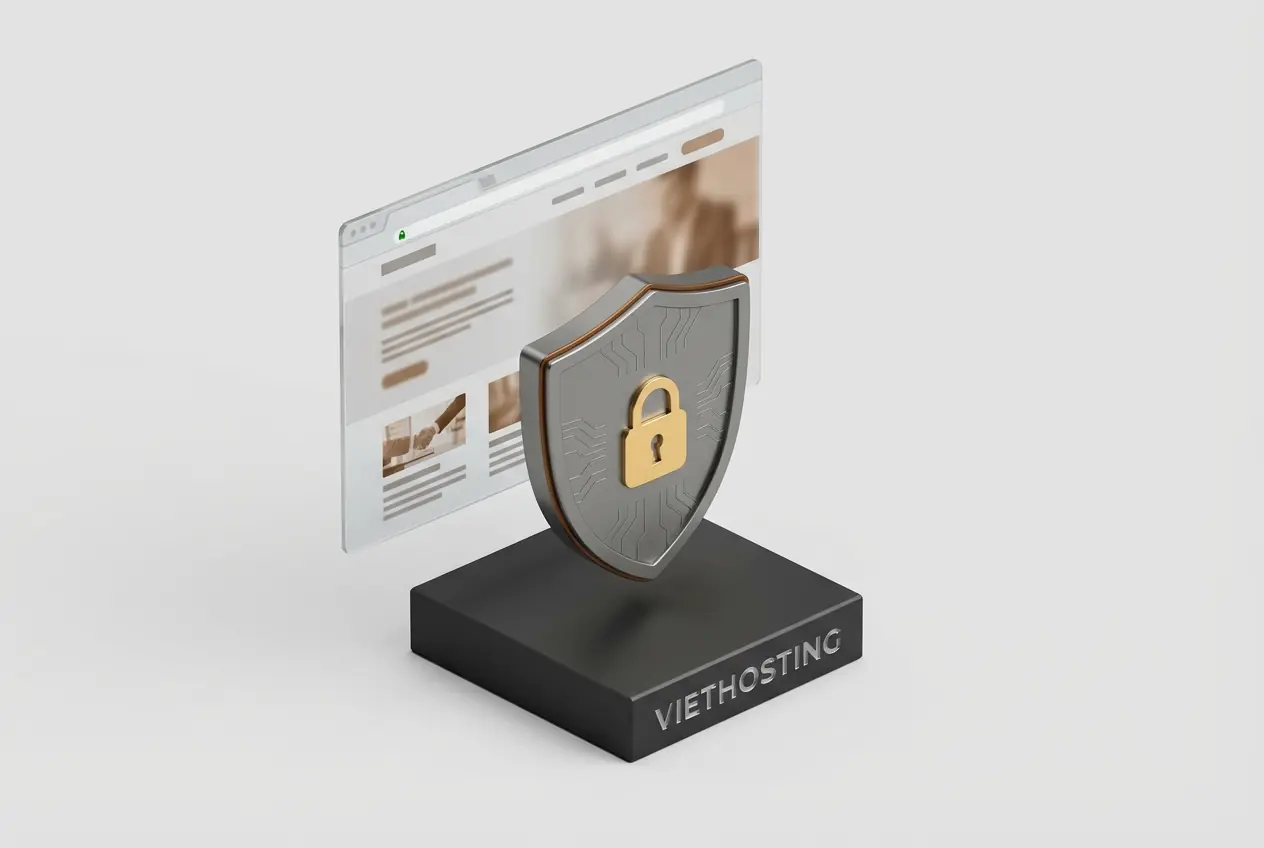
An SSL (Secure Sockets Layer) Certificate is a digital document that authenticates a website's identity and encrypts all data transmitted between a web server and a user's browser. Technically, the legacy SSL protocol has been deprecated and completely replaced by the modern TLS (Transport Layer Security) standard.
However, within the global web hosting and cybersecurity industry, the term "SSL Certificate" is still universally used as a legacy naming convention to refer to modern HTTPS certificates operating on TLS 1.2 or TLS 1.3.
In the modern Internet environment, data security is a top priority for all organizations. Equipping your systems with an SSL certificate is no longer just a technical addon; it has become a core cybersecurity standard necessary for businesses to maintain sustainable online operations.
- 1. What is an SSL Certificate?
- 2. How Does the SSL/TLS Protocol Work?
- 3. Key Benefits of SSL Certificates
- 4. Common Types of SSL Certificates
- 5. Why Does Your Website Need an SSL Certificate?
- 6. What is the Difference Between SSL and TLS?
- 7. The Difference Between SSL and HTTPS
- 8. SSL Certificate Solutions at VietHosting
- 9. Conclusion
1. What is an SSL Certificate?
An SSL Certificate is an encrypted data file that links a cryptographic key to an organization's details. Once installed on a web server, this certificate activates the security padlock and the HTTPS protocol, allowing a secure, encrypted connection to be established between the web server and the browser.
This certificate acts as an electronic "ID card" issued by trusted global Certificate Authorities (CAs). Consequently, users can accurately verify that the server infrastructure they are accessing belongs to a legitimate enterprise, entirely eliminating the risk of connecting to fraudulent phishing websites.
2. How Does the SSL/TLS Protocol Work?
The security protocol operates on the foundation of Public Key Cryptography. The process of establishing this secure connection is known as the "TLS Handshake," which occurs in mere milliseconds through the following technical steps:
- Authentication: When a browser requests access to an HTTPS website, the server responds by sending its SSL/TLS Certificate. The browser verifies the certificate's validity and cross-checks the digital signature against a list of trusted Certificate Authorities (CAs).
- Key Exchange: Upon successful authentication, the browser uses the Public Key provided in the certificate to encrypt a randomly generated secret data string, which it then sends back to the server.
- Session Encryption: The server receives this data string and uses its unique Private Key to decrypt it. From this shared secret, both parties compute a symmetric "Session Key." From this point forward, all transmitted data is symmetrically encrypted using this Session Key, ensuring high speeds and absolute security.
3. Key Benefits of SSL Certificates
Equipping an SSL certificate is no longer an optional utility but mandatory infrastructure, delivering numerous practical values:
4. Common Types of SSL Certificates
Certificate Authorities offer various types of SSL certificates, categorized by the level of identity validation and domain protection scope. Below is a detailed comparative breakdown:
| SSL Type | Validation Level | Best For |
|---|---|---|
| DV (Domain Validation) | Only verifies domain ownership via email or DNS. Extremely fast issuance (5-10 minutes). | Blogs, personal websites, forums, and informational sites that do not collect critical data. |
| OV (Organization Validation) | Verifies the organization. Requires business licenses for the CA to check corporate legitimacy. | Corporate websites, e-commerce platforms, and systems requiring high credibility. |
| EV (Extended Validation) | The strictest validation level. Demands rigorous legal vetting processes. Displays clear company details. | Large corporations, banks, financial institutions, and electronic payment gateways. |
| Wildcard (Sub-domain Protection) | Can be DV or OV. Encrypts the primary domain and an unlimited number of sub-domains (e.g., *.domain.com). | Systems with multiple secondary portals (e.g., mail.domain.com, shop.domain.com, api.domain.com). |
5. Why Does Your Website Need an SSL Certificate?
Although the HTTPS protocol is now the universal standard across the Internet, deploying SSL/TLS is strictly mandatory and urgent for the following practical reasons:
- For E-commerce Websites: Where customers perform online payments and enter credit card details. SSL is a prerequisite for systems to meet the international PCI-DSS payment security standards.
- Protecting Login and Administration Portals: Websites featuring member portals, forums, or Content Management Systems (CMS) must rigorously encrypt user account credentials and passwords.
- Safeguarding Customer Personal Data: Any website utilizing forms to collect emails, phone numbers, medical records, or contracts must encrypt this data to comply with privacy protection laws.
6. What is the Difference Between SSL and TLS?
Many users mistakenly believe SSL and TLS are two different certificates. In reality, they represent the evolution of the same encryption technology. SSL (developed by Netscape in the 1990s) harbored severe security vulnerabilities (such as POODLE, BEAST, and CRIME), leading to the official deprecation of SSL versions 1.0, 2.0, and 3.0. The internet has since fully migrated to the TLS (Transport Layer Security) standard.
- Robust Encryption Standards: TLS 1.2 and TLS 1.3 completely eliminate outdated cryptographic algorithms (RC4, MD5, SHA1) and exclusively employ modern, highly secure cipher suites such as AES-GCM or ChaCha20.
- Superior Connection Speed: The latest TLS 1.3 protocol streamlines the Handshake process down to a single Round Trip Time (1-RTT). This significantly reduces latency and accelerates page load times.
- Industry Terminology: Even though your system runs the state-of-the-art TLS 1.3 protocol, tech giants (AWS, Google, Cloudflare) and the entire hosting industry continue to call the product an "SSL Certificate" due to historical familiarity. Therefore: SSL Certificate = TLS Certificate.
Even if you purchased an "SSL Certificate," you can verify that your server is running modern TLS standards by executing the following OpenSSL command in your Linux Terminal:
openssl s_client -connect yourdomain.com:4437. The Difference Between SSL and HTTPS
Many people confuse these two terms; however, they represent two closely related yet distinct technical concepts:
- SSL/TLS: This is the data encryption technology/protocol. An SSL certificate is the product (data file) you purchase and install on the server.
- HTTPS (Hypertext Transfer Protocol Secure): This is the visual result of applying SSL technology. HTTPS is the standard Hypertext Transfer Protocol (HTTP) integrated with an additional SSL/TLS security layer. Once an SSL certificate is installed, the website URL automatically shifts from HTTP to HTTPS.
8. SSL Certificate Solutions at VietHosting
To ensure a robust security infrastructure, VietHosting provides a diverse range of SSL certificate solutions, optimized for various enterprise models:
- Premium Partner of Leading CAs: VietHosting officially distributes certificates from the world's most reputable authorities, such as DigiCert, Sectigo, and GlobalSign, ensuring 99.9% compatibility across all browsers and devices.
- Rapid Deployment: The registration, validation (for DV SSL), and certificate issuance process occurs entirely automatically within just a few minutes.
- Diverse Categories: Offering a complete portfolio of SSLs from basic (DV) to enterprise-grade (OV, EV) and multi-subdomain solutions (Wildcard SSL) at reasonable prices.
- Free Integration on Hosting Ecosystems: For clients deploying Web Hosting services (such as cPanel Hosting or DirectAdmin Hosting), VietHosting includes built-in features for the automatic issuance and renewal of free security certificates (AutoSSL/Let's Encrypt).
- In-depth Technical Support: A team of engineers with over 16 years of experience is always ready to assist customers with installing certificates (CSR, Private Key, CRT) onto Linux Servers, Windows Servers, or Web Server software (Nginx, Apache, LiteSpeed).
9. Conclusion
An SSL certificate is an essential security foundation that helps encrypt data and authenticate a website's identity on the Internet. Although the term "SSL" remains widely used in the industry, modern server systems are practically operating on the much more secure TLS 1.2 or TLS 1.3 encryption standards.
Deploying the HTTPS protocol not only ensures absolute safety for user data against cyberattacks but is also a prerequisite for enhancing brand credibility and boosting SEO rankings on search engines.
Upgrade to the HTTPS protocol today to encrypt data transmission, eliminate "Not Secure" warnings, and optimize your enterprise website's SEO rankings.