 Tiếng Việt

What Is a Server License? How It Works, Benefits & Types
A Server License is a legal permit that grants the right to install and use specialized enterprise software (Operating ...

What is LiteSpeed Web Server? Benefits & When to Use It
LiteSpeed Web Server (LSWS) is a high-performance commercial web server software, distinguished by its ability to handle ...
What is Offshore Hosting? Benefits & When to Use It
Offshore Hosting is a web hosting service where the physical servers are located in a data center outside your primary ...

What is Vietnam Web Hosting? Benefits & When to Use It
Vietnam Hosting (Vietnam Web Hosting) is a web hosting service that stores website data on servers located in data centers ...
What is DirectAdmin Hosting? Benefits & Compared to cPanel
DirectAdmin Hosting is a web hosting service that runs on a Linux server and is managed through the DirectAdmin control ...
License Pricing and Service Configuration Update
Dear Valued Customers, To ensure pricing transparency, comply with software vendor policies, and further optimize our ...
LiteSpeed vs Apache: Which Webserver is better for WordPress?
Comparing LiteSpeed and Apache for WordPress LiteSpeed and Apache are the two most popular web servers when deploying ...
Frequently Asked Questions (FAQ)
Frequently Asked Questions and Essential Knowledge about VietHosting Services
What is a Vietnam VPS?
Vietnam VPS is a virtual private server created from a physical server located in a data center in Vietnam and assigned a Vietnamese IP address. It provides dedicated computing resources such as CPU, RAM, and storage for running websites or applications.
Because the server is located within Vietnam, users in the country can access the website with lower network latency and faster loading speeds. Vietnam VPS is commonly used for websites and online services targeting Vietnamese users.
How to Choose a High-Quality Vietnam VPS?
To choose a high-quality Vietnam VPS, you should evaluate the hosting provider based on several technical factors such as virtualization technology, physical server hardware, and network infrastructure.
For more detailed explanations about choosing the right VPS provider, see the following guides:
What is an Offshore VPS?
Offshore VPS is a virtual private server created from a physical server located in a data center outside the user's country. It provides dedicated resources such as CPU, RAM, and storage for hosting websites or applications.
Offshore VPS servers are commonly located in regions such as Singapore, Hong Kong, the United States, or Europe. They are typically used when a website targets international users or needs a server located closer to a specific global market.
Vietnam VPS vs. Offshore VPS: Which one to choose?
Choosing between a Vietnam VPS and an Offshore VPS mainly depends on your target audience location and international bandwidth requirements.
If your primary audience is in Vietnam, deploying a Vietnam-based VPS usually delivers better performance and user experience.
For a detailed comparison and deployment considerations, see the following guides:
What is a KVM VPS?
KVM VPS is a Virtual Private Server that uses KVM (Kernel-based Virtual Machine) virtualization technology. This hardware virtualization method allows each VPS to run as an independent server with dedicated CPU, RAM, and storage resources.
KVM is integrated directly into the Linux kernel, providing strong performance and flexibility. KVM VPS is commonly used to host websites, web applications, game servers, and other workloads that require an isolated server environment.
What is the performance of KVM VPS at VietHosting?
The image below shows the real benchmark results measured on a live KVM VPS server at VietHosting:
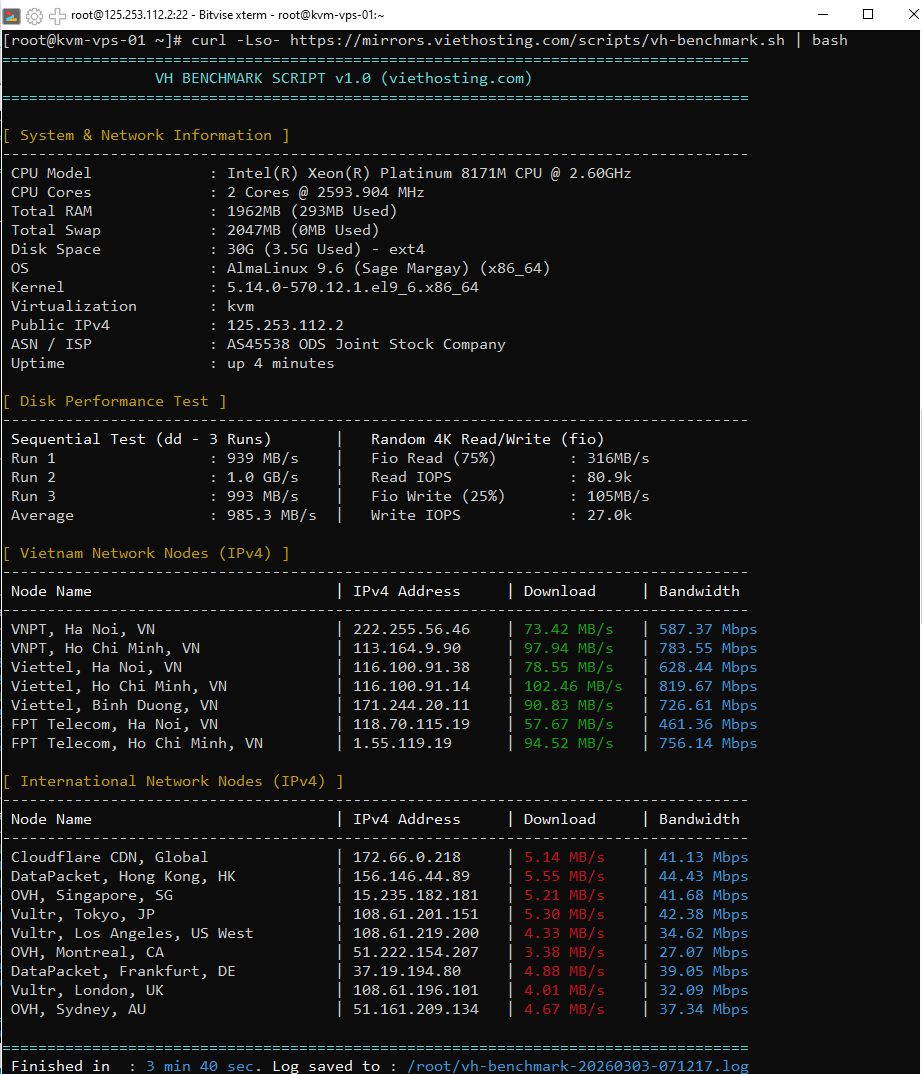
* The benchmark was performed using the VH Benchmark Script on a production server.
* Our VPS plans include network speeds of 1Gbps (Domestic) / 32Mbps (International).
* This represents the maximum shared bandwidth available for each VPS.
Can I install Windows on KVM VPS?
Yes. You can install Windows Server on KVM VPS services at VietHosting.
With KVM (Kernel-based Virtual Machine) virtualization, each VPS operates similarly to an independent physical server with dedicated CPU, RAM, and storage resources. This allows the VPS to run multiple operating systems, including Windows Server, reliably.
Commonly supported Windows Server versions include:
Note: Windows Server requires a valid license. Customers may provide their own license (BYOL – Bring Your Own License) or purchase a license through VietHosting.
What are the available OS for KVM VPS?
KVM VPS services at VietHosting are managed through the Virtualizor control panel, allowing customers to install operating systems automatically with just a few clicks.
The commonly available operating systems include:
Customers may also install other operating systems using a custom ISO image and access the VPS console through noVNC directly from the control panel.
What is a Large VPS?
Large VPS, also known as a high-resource VPS, is a type of Virtual Private Server that provides large allocations of CPU, RAM, and storage resources. It delivers higher performance compared to standard VPS plans.
Large VPS is commonly used for high-traffic websites, e-commerce platforms, large databases, and demanding web applications. It sits between a regular VPS and a dedicated server in terms of performance and resources.
What are Large VPS vs. KVM VPS differences?
Large VPS is essentially a high-resource version of a standard KVM VPS. Both use KVM virtualization, but Large VPS plans provide significantly more CPU, RAM, and storage resources to support high-performance workloads.
Similarities:
Key Differences:
- KVM VPS: Suitable for websites and applications with low to medium resource requirements.
- Large VPS: Provides larger CPU, RAM, and storage allocations, making it suitable for high-traffic websites, e-commerce systems, and resource-intensive applications.
Large VPS vs. Dedicated Server: Which one to choose?
Large VPS and Dedicated Server are both high-performance server solutions, but they differ in architecture and flexibility.
- Large VPS: A virtual server powered by KVM virtualization, offering large dedicated resources with fast deployment, flexible upgrades, and lower cost.
- Dedicated Server: A full physical server exclusively allocated to you, delivering maximum hardware performance and full hardware customization.
In short, Large VPS is ideal for projects that require powerful resources with flexibility and cost efficiency, while a Dedicated Server is better suited for workloads that demand absolute performance and complete hardware isolation.
To learn more about each solution, please refer to the detailed guides below:
An Explanation of Bandwidth (Mbps, Domestic, International)?
1. What is Bandwidth?
Bandwidth is the maximum amount of data that can be transferred through a network connection within a specific period, usually measured in Mbps (Megabits per second) or Gbps.
The larger the bandwidth, the more data can be transferred between the server and users every second.
2. Mbps vs MB/s
Internet providers typically advertise speed in Mbps (Megabits per second), while browsers and download software display speeds in MB/s (Megabytes per second).
- 1 Byte = 8 bits
- Therefore: 1 MB/s = 8 Mbps
- Example: A connection of 100 Mbps equals a theoretical download speed of about 12.5 MB/s.
3. Domestic Bandwidth
Domestic bandwidth refers to network traffic within Vietnam. It usually provides lower latency and higher speeds for users located in the country.
4. International Bandwidth
International bandwidth refers to connections between Vietnam and other countries. Due to geographical distance and international routing, latency and speed may vary.
5. VietHosting Bandwidth Policy
VietHosting operates on a shared bandwidth model. The advertised speed represents the maximum port speed allocated to the service.
If your project requires more stable network performance or dedicated bandwidth, please contact VietHosting for suitable solutions.