 Tiếng Việt

Introduction to VH Benchmark Script
VH Benchmark Script is an open-source VPS and server benchmark tool developed by VietHosting. The script is designed to quickly test CPU performance, Disk I/O and network speed on Linux servers using a single command.
1. What is VH Benchmark Script?
VH Benchmark Script is an open-source Bash script designed to quickly test the CPU performance, Disk I/O, and network speeds of Linux servers. The script measures connection speeds to multiple nodes across Vietnam and global locations, helping evaluate real-world server performance and network quality.
Developed by VietHosting, the script aims to offer a simple, transparent, and easy-to-use method for testing server performance. Users can run the benchmark with a single command and view the results directly in the terminal.
Unlike many complex benchmarking tools that require additional software installation, VH Benchmark Script runs natively on most popular Linux distributions. What sets this tool apart is its capability to measure network speeds to major Vietnamese ISPs, such as VNPT, Viettel, and FPT, alongside numerous global nodes, providing more realistic network performance results for users in Vietnam.
In short, VH Benchmark Script helps you quickly evaluate the performance of your VPS or Linux server in just a few minutes.
2. Why Benchmark Your VPS or Server?
Benchmarking a VPS or server allows you to assess the system's actual performance, helping you identify potential bottlenecks related to CPU, storage speed (Disk I/O), or network bandwidth limitations.
By reviewing the result tables, you can easily verify whether the hardware configuration matches the provider's commitments. It also provides objective data for comparing different hosting providers before deploying your system into a production environment.
3. Key Benchmarking Metrics
Upon execution, the script gathers and benchmarks the most critical components that determine server performance:
- System Information: Displays CPU model, core count, clock frequency, RAM capacity, disk space, operating system, and virtualization technology (e.g., KVM, VMware).
- Disk I/O Performance: Tests sequential write speed using the
ddcommand and automatically measures random 4K read/write speeds usingfioif installed. - Network Speed: Measures download speeds from network nodes in Vietnam and multiple international regions (Asia, Europe, Americas).
- ISP Information: Displays the server's public IP address, ASN, and network provider name.
The benchmark results are displayed directly on the terminal in an intuitive table format, making it easy for users to read, compare, and save the test results.
4. How to Install and Use VH Benchmark Script
The benchmarking process is typically completed very quickly, taking only 2–3 minutes depending on your VPS configuration and network connection speed.
4.1. Install Required Packages
System Requirements: The server must have curl installed to download the script. It is highly recommended to install fio so the script can measure disk IOPS accurately.
If your server does not have these libraries installed, run the command corresponding to your operating system:
- For Ubuntu / Debian:
apt-get update -y && apt-get install curl fio -y - For CentOS / AlmaLinux / Rocky Linux:
dnf install curl fio -yFor older distributions such as CentOS 7, you may need to install
epel-releaseand useyuminstead:yum install epel-release -y && yum install curl fio -y
4.2. Run the Benchmark Command
Log in to your server via SSH with root privileges and execute the following command to start the comprehensive test:
curl -Lso- https://mirrors.viethosting.com/scripts/vh-benchmark.sh | bashAlternatively, if you want to save time and only test network speeds in a specific region, use the following optional parameters:
curl -Lso- https://mirrors.viethosting.com/scripts/vh-benchmark.sh | bash -s vn # Test connection speeds to international network nodes only
curl -Lso- https://mirrors.viethosting.com/scripts/vh-benchmark.sh | bash -s intl5. Sample Output
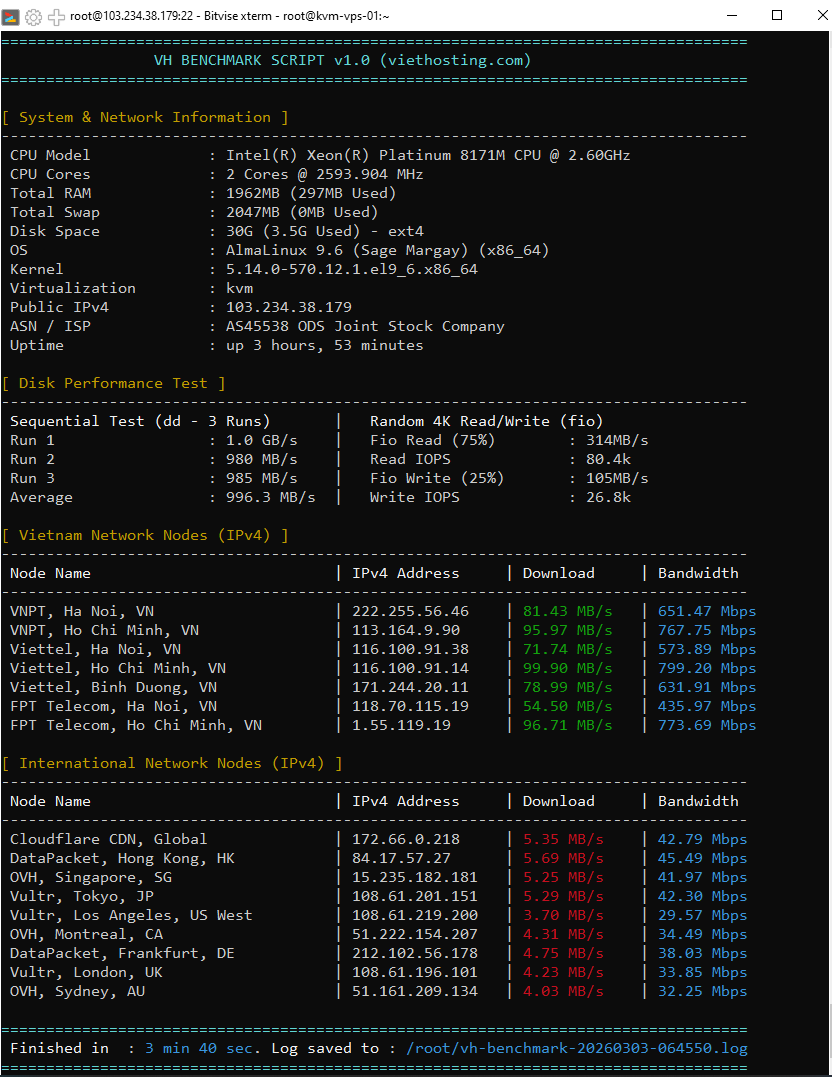
Once completed, the results will be displayed immediately on the terminal screen and simultaneously saved as a log file (e.g., /root/vh-benchmark-20260303-064550.log) in the current directory for easy sharing. The image below is an example of output from a real server:
6. VH Benchmark Script vs. Other Benchmarking Tools
There are many popular VPS and server benchmarking tools available on the internet. Each tool has its own strengths and approach. The table below provides an overview of the differences between VH Benchmark Script and other popular benchmarking tools:
| Core Feature | VH Benchmark Script | Other Popular Benchmark Tools |
|---|---|---|
| Network Testing Focus | Comprehensive Vietnam & Global Nodes | Almost entirely Global Nodes |
| Disk I/O Performance | Combines dd and fio |
Typically uses only fio or dd |
| API Rate Limit Mitigation | Yes (Automatic Fallback) | Limited support (Prone to errors with frequent testing) |
| Execution Speed | Fast execution (2–3 minutes) | Varies (Can be very slow if Geekbench is included) |
7. Real-world VietHosting VPS Performance Test
To illustrate how the script operates in a real-world environment, below are random benchmark results performed on a server from the basic KVM VPS plan operating within VietHosting's infrastructure. These results reflect the actual hardware performance and network stability.
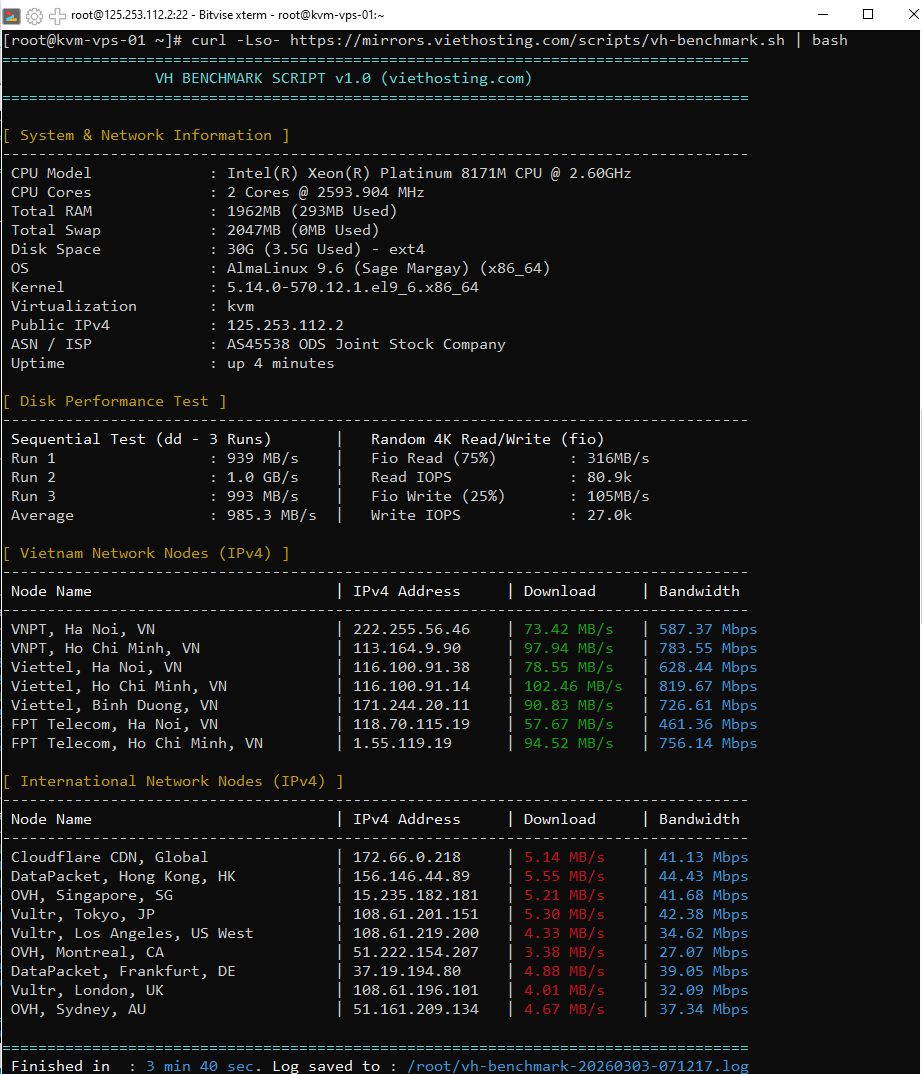
Video 01: Real-world benchmark on KVM VPS (Node features Dual Intel Xeon Platinum 8171M CPUs, SSD RAID-10 storage).
Video 02: Real-world Benchmark on KVM VPS (Legacy Infrastructure).
- VietHosting's VPS plans currently offer maximum shared bandwidth configurations of up to 1 Gbps for domestic connections and 32 Mbps for international routing.
8. Conclusion
Running the VH Benchmark Script regularly is a good practice to keep track of your server's health. By displaying clear and transparent metrics, we hope this tool will serve as a valuable companion for system administrators.
You can test your system's performance using the VH Benchmark Script on a KVM VPS or Large VPS at VietHosting and experience the real performance of the infrastructure with just a single command.